

Somewhere along the way, Attio became a company I seemed to know before I knew much of anything about it.
I couldn’t tell you where I first encountered the name. I hadn’t used the product, visited the website, or studied the company. If someone had asked what Attio did, I could have offered only a vague description of a new kind of CRM.
Yet the company already occupied a definite place in my mind. Attio felt modern, design-led, slightly elite, and associated with companies operating a few years ahead.
What caught my attention was the mismatch between how little I actually knew and how complete my impression felt.
I had assigned it status before gathering enough information to justify that status.
Wispr Flow entered my awareness similarly. Its name began appearing among people whose use of AI seemed more advanced, but nobody paused to explain it.
They spoke as though everyone serious already understood the reference, and that absence of explanation became part of the signal.
Loom offers a more visible version. Most people met it through a recording someone sent, not a campaign. By the time they reached the company’s website, the product had already entered the language and routine of work. “Send them a Loom” no longer required explanation.
The consumer examples are even more potent because they circulate through fashion, entertainment, taste, and status. TikTok, Shein, Temu, Discord, Balenciaga, High Noon, HOKA, Oura, Celsius, Alo Yoga, and Liquid Death all seemed to arrive with a distinct character attached.
They felt futuristic, transgressive, fashionable, or culturally charged before many people could explain what the companies sold or how they became so prominent.
I never made a conscious decision to investigate most of these brands. I experienced their effects first. By the time I looked directly, they had already taken up residence in my mind.
I call this the Ambient Infiltration Effect:
Ambient infiltration occurs when an encoded brand identity enters public consciousness before people consciously decide to pay attention, allowing recognition, character, and status to form before anyone can fully trace where those impressions came from.
The strange part is the amount of meaning that seems to arrive without explanation. You recognize the name, understand roughly what kind of world it belongs to, and sense that it carries weight, yet you cannot reconstruct exactly how it entered your awareness or why you already feel that way.
The brand is the encoded object
People will naturally reach for repetition or the mere-exposure effect. Both account for familiarity: seeing the same company often enough makes its name easier to recall and can soften our resistance to it.
But neither explains why certain brands arrive carrying specific impressions of status, danger, authority, expense, or cultural importance before we know much about the business.
Forty retargeting ads can make a name memorable, but the hand behind that familiarity is obvious. Ambient infiltration is stranger because the meaning often seems to precede the explanation. Something has already been built into the identity before distribution begins multiplying it.
The brand itself is the encoded object. Its name, phonetics, symbol, color, shape, and archetype deliver meaning beneath conscious analysis, even before distribution multiplies it.
That’s the difference between recognizing a company and sensing something around it.
High Noon invokes the sun at its apex, the charged moment before a Western showdown, summer heat, peak experience, and a slight edge of danger.
Oura sounds like aura, while the ring resembles a small talisman capable of reading signals hidden inside the body.
HOKA combines an unusual, almost chant-like name with an oversized silhouette that appears elevated, technical, and unlike the conventional running shoes surrounding it.
In all these cases, the raw identity has already begun directing perception before a campaign spells anything out.
Balenciaga is one brand that carries a… darker… charge. Its long, incantatory name, severe wordmark, monochrome world, distorted forms, ritualistic staging, and recurring flirtation with taboo make the identity feel almost initiatory. Some people hear Baal in the opening syllable and interpret the brand as demonic (Balenciaga is actually the surname of founder Cristóbal Balenciaga, not an etymological reference to the ancient deity). But symbols don’t wait for etymological permission. The company has spent years constructing such a dark symbolic field around the name that the interpretation feels psychologically plausible.
Its imagery repeatedly invites readings involving profanation, forbidden power, moral inversion, and the occult. Balenciaga never has to declare itself demonic. It has encoded enough darkness into the identity that the audience supplies the demonology, while celebrities and rappers carry its symbols into public and give that code status, repetition, and cultural reach.
Their audience does not encounter a blank name and wait for advertising to fill it with meaning. It encounters an identity that already contains a theory of itself.
There is something subliminal happening here, although I don’t mean a bottle of Coke hidden inside one frame of a movie. The brand can be completely visible. What remains hidden is the instruction embedded within it.
That instruction rarely arrives as a literal sentence. It is a felt orientation toward the company: this belongs to the future; people ahead of me understand it; possession grants entry into a particular world; there is enough danger here to deserve attention.
By the time the conscious mind sees a name, color, symbol, or shape, those forms have already framed the judgment. Color reaches us before copy, sound before definition, and symbol before any commercial argument.
The word occult originally refers to something hidden or concealed. I spent years studying occult ideas after my spiritual awakening, and this distinction is crucial:
In ambient infiltration, the brand isn’t hidden. The operation taking place through it is. You can inspect the object clearly while remaining unable to explain why it feels charged.
Repetition strengthens the original encoding rather than creating meaning from nothing. An early encounter establishes the association; later encounters make it feel stable, familiar, and self-evident. With enough reinforcement, the name can begin to seem as though it possesses an energy of its own, detached from the individual design choices and encounters that produced the impression.
A 1989 experiment by psychologist Larry Jacoby and his colleagues reveals one part of this process. Participants read a list of names they were explicitly told belonged to non-famous people. When tested immediately, they remembered that instruction. After 24 hours, however, they became more likely to identify those same names as famous.
The familiarity survived after its source faded. Jacoby and his colleagues called the phenomenon “becoming famous overnight.” The participants retained the recognition while losing the receipt that explained where it came from.
Ambient infiltration leaves behind more than recognition. A brand can preserve a remarkably specific character in memory (e.g., prestige, expense, danger, technological sophistication) even after the individual cues that produced the impression have disappeared.
You may no longer remember the typeface, color, silhouette, celebrity, or setting, yet still feel certain about what kind of company this is and where it belongs in culture. The mind has discarded much of the evidence while preserving the verdict.
That is ambient authority: the sense that an entity already possesses power before we have examined why.
The logo is a sigil
Once I began thinking of the brand as an encoded object, its relationship to magic stopped looking merely metaphorical. Both practices work through names, symbols, colors, physical objects, repetition, attention, belief, and ritual. Corporate language has made these instruments sound hygienic (visual identity, brand salience, distinctive assets), but the operation is remarkably similar.
An intention is attached to a form and repeatedly presented until the audience feels something in its presence without reconstructing how the association was built.
A company name does more than identify a business. It becomes a phrase that customers, employees, investors, creators, and strangers repeatedly invoke.
The logo concentrates the identity into a portable symbol.
Color establishes an emotional register before language arrives, while the product itself can become a physical vessel for everything the brand represents. Consistency allows those associations to deepen until an ordinary commercial encounter begins to resemble a ritual.
Occult traditions have a term for what can emerge from sustained collective attention: an egregore, or a thought-form sustained by a group.
A company exists through employees, contracts, products, intellectual property, and bank accounts. The brand develops a second existence inside people who may know almost nothing about those structures. It can survive a founder, outlive a product, cross borders, and provoke loyalty or hatred in people who have never read its history.
Nike demonstrates the mechanism unusually well. Its name invokes the Greek goddess of victory, while the Swoosh gave that idea a form capable of traveling on the human body without explanation.
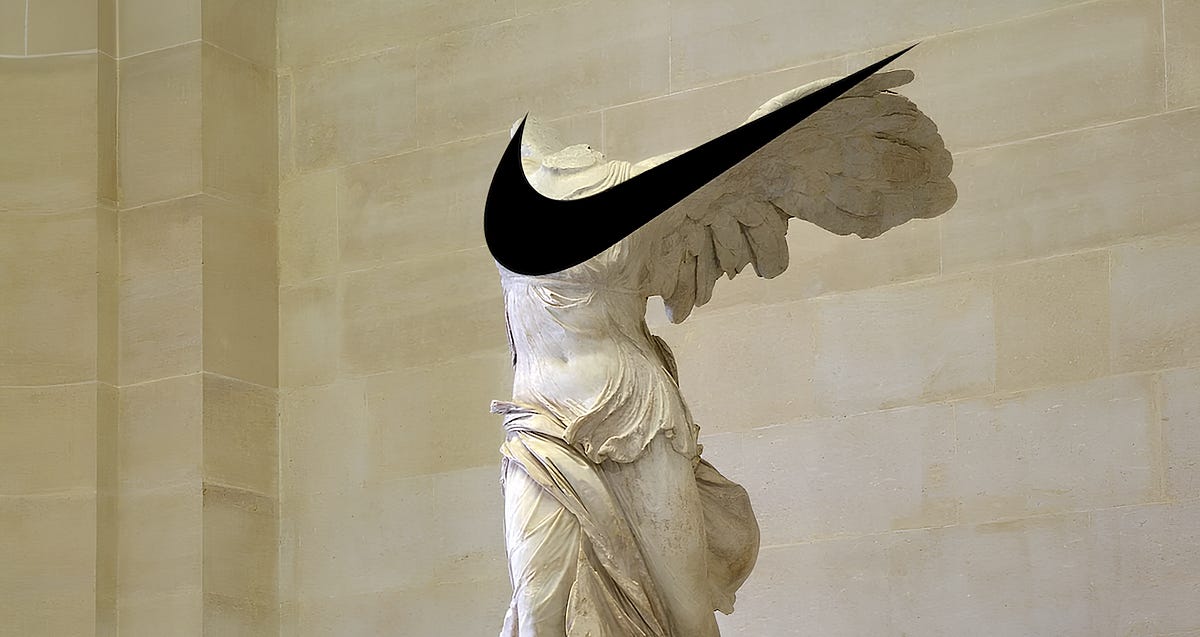
Nike’s own account of the mark’s history notes that it began appearing “in the right places,” including on leading finishers at the 1972 Boston Marathon, before becoming a global icon.
Those athletes’ bodies completed the symbol by attaching it to speed, discipline, exertion, achievement, and public victory. Every performance added meaning to the mark until the Swoosh could communicate an entire athletic worldview on its own.
Starbucks makes the connection to enchantment even more explicit. The company chose a twin-tailed siren from Greek mythology, which Starbucks describes as a “seductive twin-tailed mermaid” discovered in an old marine book. The defining power of the siren was irresistible attraction, making her an almost unnervingly appropriate symbol for a company built around habitual desire.
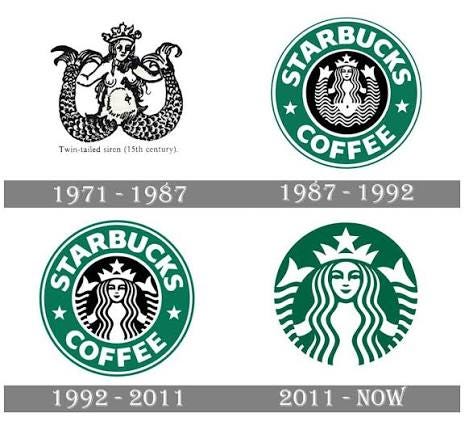
Over time, the green mark migrated from storefronts onto cups carried through offices, airports, sidewalks, and meetings. The customer bought coffee, but also carried the siren into public and strengthened the association between Starbucks and a particular kind of daily ritual.
Technology companies regularly borrow this power through their names:
Oracle implies hidden truth
Palantir takes its name from a seeing stone capable of perceiving events across impossible distances
Anduril invokes a legendary sword
Loom evokes separate threads woven together
Wispr Flow places quiet speech and uninterrupted thought inside the name itself
TikTok imitates a clock, carrying rhythm, urgency, and the sense of time disappearing
These names establish the world in which the product will be understood.
Color and physical form can become equally charged: Tiffany blue, Hermès orange, Barbie pink, and Bottega green summon entire identities without a wordmark.
Apple’s white earbuds, the contour of a Coca-Cola bottle, and HOKA’s exaggerated sole identify the product from across a room.
The object has become a sigil in public space.
None of this requires every CMO to be privately practicing ceremonial magic. Some brands knowingly use mythology, numerology, esoteric imagery, archetypes, and symbolic correspondences (there is power in knowledge, so if you’ve got it, use it!). Others arrive at similar methods through instinct, design history, or the accumulated pattern recognition of talented creative people.
Once enough attention, emotion, memory, and repetition gather around an identity, the public begins animating it on the company’s behalf.
How the code takes hold
The code becomes ambient once it can leave the company and remain intact.
Brands travel through objects people have their own reasons to use: shoes, cups, screenshots, recordings, templates, exported videos, and phrases repeated in conversation. The artifact moves an encoded identity into a new setting, where the surroundings appear to confirm what the brand has implied all along.
The public then begins sustaining the identity. People wear the symbol, carry the object, repeat the name, imitate the aesthetic, adopt the language, and share the output. They receive utility, pleasure, status, belonging, or self-expression; the brand receives thousands of small reenactments that no media plan could fully orchestrate.
These sightings appear to validate one another. Finding the same company among runners, founders, artists, athletes, or people whose taste you trust creates the impression that the identity has a life beyond its own advertising.
The environment supplies social proof, but the identity supplies the meaning. A generic name and interchangeable visual system can become widely recognized through spending. They rarely acquire this kind of charge because there is so little for attention to gather around.
As a note on continuity of brand personality: constant reinvention quietly damages the effect.
Startups that rename, redesign, recolor, and reposition themselves every few months are treating identity as a creative project rather than a structure being built in memory. Every reset asks the audience to relearn the object. A sigil has to remain stable long enough to accumulate associations.
The strongest ambient brands also leave part of their meaning unresolved. They repeat the identity without explaining every symbol or association, giving the audience room to complete the thought.
A conclusion reached privately penetrates more deeply than a claim announced in an ad, because the observer experiences the judgment as self-generated.
And so, ambient infiltration conceals interpretation (not exposure). The name, logo, colors, and product may be visible everywhere; what stays below deliberate awareness is the instruction being activated through them.
By the time someone decides to investigate a company, the code may have been operating for months. Conscious evaluation begins after a deeper judgment has already formed.
The founder’s darker opportunity
Most startups try to win through volume: more posts, more ads, more explanations, more channels repeating the same claim. Ambient infiltration requires a different sequence:
Seed evidence first, delay the full explanation, and let people sense a presence without seeing the entire promotional apparatus behind it.
This doesn’t mean hiding the company. It means withholding complete visibility, access, or understanding off the bat. A few ways to actually do that are to:
Encode the identity before distributing it. Choose a name, mark, color, sound, or product form with enough symbolic charge to create a feeling on contact. Distribution cannot enchant a generic object.
Release artifacts before announcements. Circulate a striking output, prototype, score, report, object, or screenshot before publishing the manifesto that explains it. Give people evidence that something exists before telling them what to conclude.
Stagger sightings across small, adjacent worlds. Seed the same identity through niche communities whose members overlap just enough to transmit the signal: a private Slack, specialist podcast, founder dinner, Discord, newsletter, or subculture. Avoid the synchronized footprint of a campaign.
Choose carriers, not influencers. Give early access to people whose taste, status, or behavior already embodies the meaning you want attached to the brand. A dozen correct carriers can charge a symbol more deeply than a thousand paid mentions.
Create language insiders can use. Name a behavior, problem, identity, or emerging category before the rest of the market has words for it. Proprietary language becomes especially powerful when people repeat it without needing to mention who invented it.
Reveal the company in installments. Introduce the name, then the object, then the language, then the fuller story. Partial product footage, numbered beta cohorts, seasonal demos, and timed releases create a rhythm of disclosure without explaining the entire world at once.
Turn access into a threshold. Applications, referrals, invite codes, private previews, customer councils, limited beta seats, and approval-based demos can make entry feel conferred rather than purchased. The constraint has to be real; fake scarcity smells like a funnel.
Introduce controlled friction. A strange spelling, visual anomaly, recurring motif, unusual product silhouette, or refusal to imitate category aesthetics gives the mind something it cannot instantly classify. The unresolved detail keeps the identity psychologically active.
Protect the unanswered question. Don’t explain every symbol, answer every interpretation, or convert every spark of curiosity into a retargeting sequence. Once the audience begins wondering what the brand means, strategic silence can carry more force than another message.
The strategy depends on delayed resolution rather than obscurity. People encounter the code, notice other people carrying it, and begin investigating under the impression that the curiosity originated inside them.
By the time the company finally explains itself, the explanation lands as confirmation rather than introduction.
By the time you finally look directly, discovery is already over… you’re simply catching up to an impression that formed before you knew to question it.