

One of the stranger rituals in venture-backed software happens immediately after a company raises money.
The founders announce the round, thank the investors, then unveil a hiring plan with 30, 50, sometimes 100 open positions.
Before those employees have built, sold, or improved anything, headcount starts functioning as evidence that the company is winning.
I understand the logic. Capital is supposed to buy acceleration, and people have historically been the machinery of acceleration.
But every time I see one of these announcements now, I wonder whether anyone actually calculated which roles the company needs, what each person should produce, and the expected return on that headcount.
Or are they hiring this way because venture-backed companies have always converted capital into departments?
AI has broken that equation. A small number of exceptional people can now produce at a range, speed, and degree of coordination that would have looked structurally impossible a few years ago.
A company built for the Ubiquity Era should reach much further with far fewer people.
Every serious hire now needs to be full-stack within their function. They should command models, agents, proprietary context, automation, and outside specialists as part of the ordinary workday. One person must cover the productive range that once required several narrow roles, repeated handoffs, and at least one manager to coordinate them.
A small, talented, AI-native company can prototype in hours, turn customer feedback into production-ready features in days, ship weekly, test several product directions before a conventional team approves one, and enter a category before anyone has decided who owns it.
Meanwhile, the larger competitor is writing job descriptions, onboarding managers, establishing reporting lines, and passing work between six separate functions.
By the time the larger company is ready to act, the smaller one may have already shaped customer expectations and become the default reference point.
The dominant company of the future may not look dominant from the inside. It may have five to ten people.
AI-Native Means Two Different Things
Most discussion about AI-native companies starts and ends with the product: Does it use a language model? Does it contain an assistant? Can the user type into a chat box?
Those are feature questions.
The more important question is whether AI changes the amount of work the product performs.
An AI-native product completes a consequential share of the customer’s objective. Remove the intelligence and the central promise, workflow, speed, economics, and output all change. For instance:
Remove AI from Cursor and it becomes a conventional code editor
Remove AI from Perplexity and it becomes a search interface presenting links
Remove AI from Lovable and the jump from a plain-language idea to functioning software disappears
The intelligence is performing part of the job.
Now apply the same standard to the company behind the product.
An AI-native company designs its roles, workflows, data, decisions, and hiring around the assumption that every operator directs intelligent systems as part of ordinary work.
Take those systems away. Does product velocity fall materially? Does marketing production drop? Does account research become generic? Would the company need another 20 people to maintain its pace?
If the answer is no, AI remains a productivity accessory inside a conventional organization.
The highest leverage appears when both the product and the company are AI-native.
The product completes more of the customer’s objective while the organization learns, builds, sells, and adapts faster than the market expects.
The Market Is No Longer the Software Budget
Software founders traditionally evaluated markets by counting seats.
How many potential users exist? What will each user pay annually? How much software budget can the company capture?
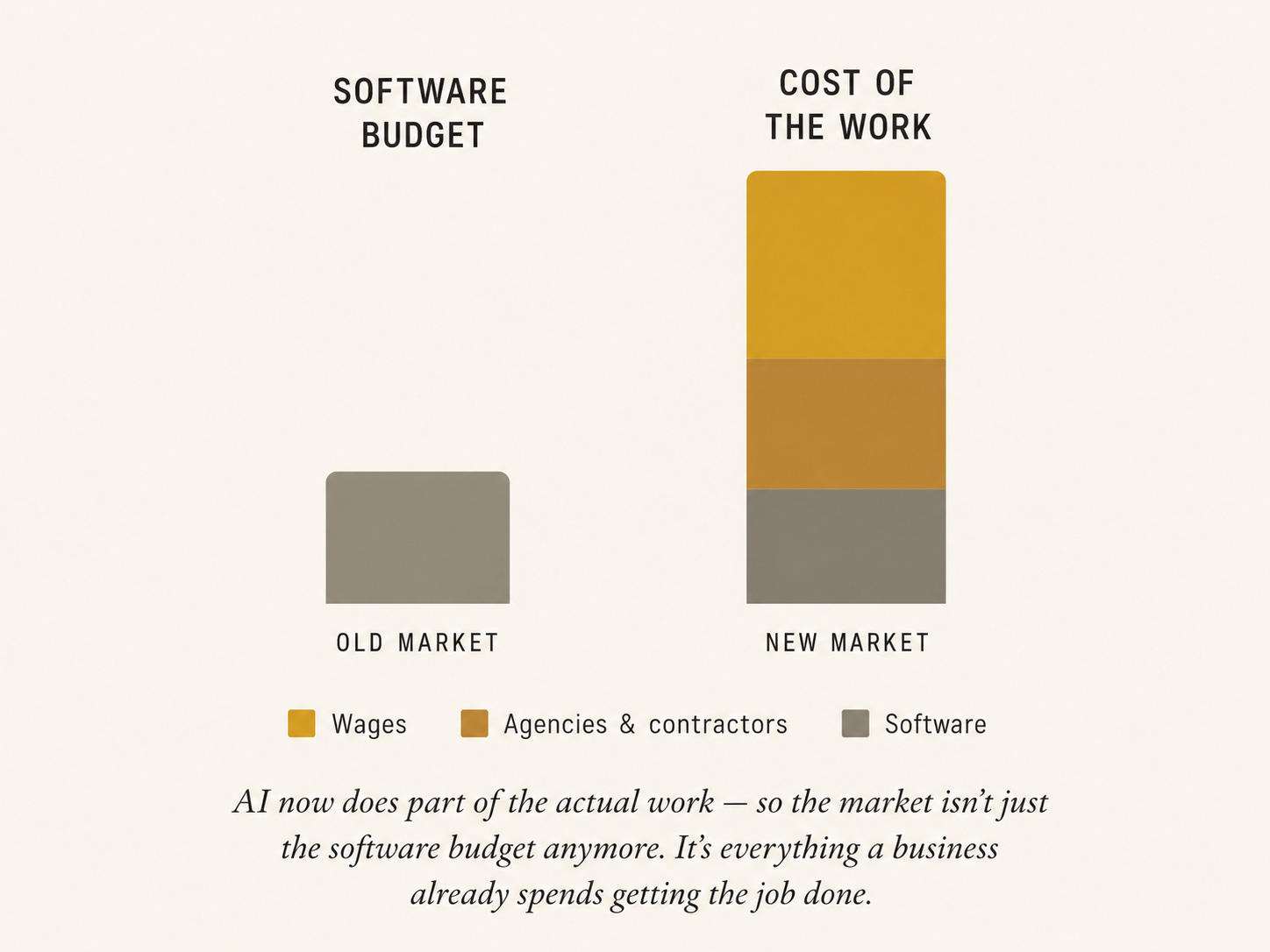
That calculation made sense when software helped a person perform a job but AI can now perform part of the job itself.
Take a law firm.
The firm spends far more money on research, drafting, review, negotiation, and the people completing the work than the legal software alone.
Traditional legal software sells a tool to the lawyer; An AI-native legal product can complete part of the legal objective.
The relevant market is no longer limited to software spend. It extends into payroll, professional fees, outsourcing, and the total cost of producing the work.
The same shift is happening across healthcare, accounting, insurance, customer support, software development, sales, design, and marketing.
The market is no longer simply: How many companies will buy this software?
It becomes: How much does the customer already spend getting this job done?
That is a radically larger question.
It also creates a higher standard. An old workflow with a faster button may support a respectable company. A category-defining AI product assumes responsibility for more of the result.
It moves from helping with the work to participating in the economics of the work.
The Best AI-Native Categories Carry Their Own Distribution
A large labor pool is only the starting condition. The strongest AI categories emerge when four forces reinforce one another:
A painful cost base already exists. The buyer is already paying through wages, professional fees, delays, errors, or lost revenue. AI is entering an active budget, not inventing demand from scratch.
The work arrives in machine-readable form. Calls, code, documents, images, messages, forms, and transactions give the product direct access to the objective without requiring the customer to redesign its entire operation.
Model capability has crossed the reliability threshold. A compelling demo is irrelevant if the product fails under imperfect inputs, repeated use, or real economic consequences. The category opens when the system becomes dependable enough to absorb meaningful responsibility.
The output travels beyond the original user. This is the overlooked force. A coding agent launches software others use; voice AI speaks with customers; research gets cited; creative outputs enter feeds, ads, and presentations.
In each case, usage generates exposure. The product leaves evidence inside the market, allowing value creation to double as distribution.
That changes the growth economics. Each completed task can introduce the company to another buyer, user, or institution without another paid impression or outbound message.
The company carries less of its own awareness.
The market starts carrying it.
Timing Still Decides Who Wins
Technical capability arrives before market readiness.
The first phase is spectacle: impressive demos, viral clips, and products that work just well enough under controlled conditions to make the future feel obvious.
The real opening comes later, when reliability improves, costs fall, interfaces become usable, and the product can survive ordinary customers, messy inputs, and repeated use.
That window is narrow.
Enter too early and the company pays for technical failure, customer education, and expectations the product cannot yet meet. Enter too late and the market has already assigned authority. Buyers know the category names, distribution favors the perceived leaders, and switching becomes harder even when a newcomer is technically better.
AI makes this timing unusually unstable. A weak product idea in January may become viable by September. A differentiated feature can become standard model capability one quarter later.
Founders therefore need a category thesis that updates continuously:
What became technically possible in the last six months?
Where are users forcing several tools into one improvised workflow?
Which task has crossed from impressive demo to dependable execution?
Which incumbent is still selling seats while the underlying objective becomes automatable?
Which valuable category still lacks an obvious default company?
Small teams have a structural advantage here because customer evidence reaches decision-makers before it loses meaning.
A nine-person company can observe a behavior on Monday, understand the commercial implication by Tuesday, rebuild around it on Wednesday, and ship before the larger competitor finishes circulating the research.
AI reduces the distance between insight and execution.
A small organization reduces the distance between the customer and the person authorized to act.
The Full-Stack Operator
The old company was designed around scarce manual production. (Example: A writer produced copy, a designer turned it into an asset, a campaign manager launched it, an analyst interpreted the result, and a manager kept the sequence moving).
Every handoff added time, stripped away context, and weakened accountability. The system optimized for specialization because one person could not realistically execute the whole outcome.
AI changes that constraint.
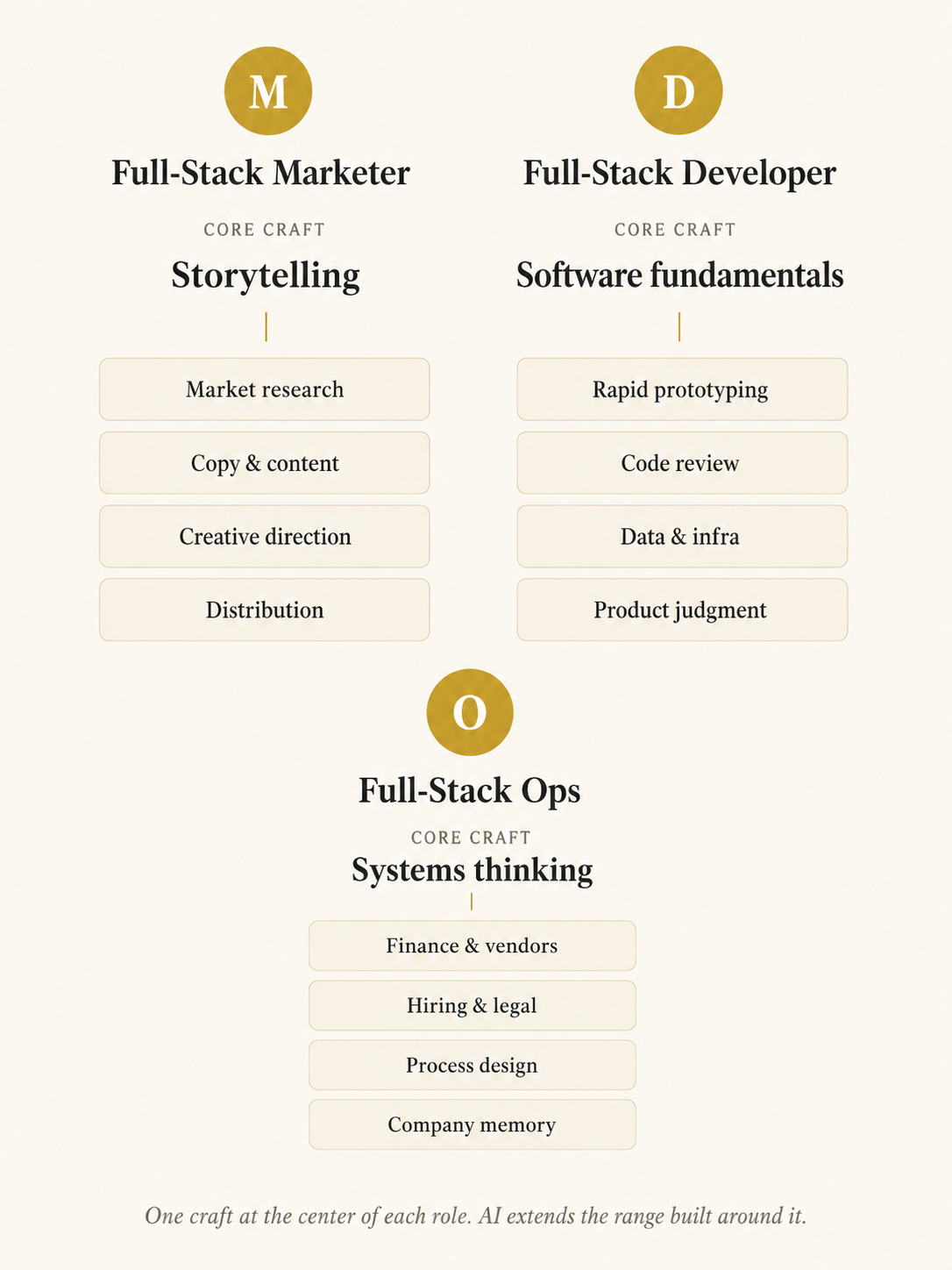
A full-stack operator is not a generalist doing five jobs badly. They have one serious craft at the center, enough commercial understanding to connect the work to revenue or adoption, and the judgment to direct models, agents, automation, and specialists across everything adjacent to it.
Generalists help across functions; full-stack operators remain accountable for the result.
A full-stack engineer can move from customer behavior to prototype, generated code, testing, infrastructure decisions, and a production release without treating product judgment as someone else’s responsibility. A marketer can research the category, sharpen the position, write the narrative, direct creative, launch distribution, and read the market response. A seller can identify the right account, develop an informed point of view, produce the outreach and presentation, run discovery, and carry the deal forward.
The craft remains the anchor. Without technical depth, taste, or commercial instinct, AI simply helps someone produce weak work faster.
Expertise is becoming more valuable because it can now command a much wider field.
What the Nine-Person Company Looks Like
I do not believe every future billion-dollar company will employ five to ten people. For me, nine is a good sweet spot. I do believe founders should build as though that might be enough for much longer than they currently assume.
Here’s how it could work:
Two founders
They own category direction, product judgment, capital, recruiting, strategic relationships, and the public story.
Their real responsibility remains human: deciding what the company means, where it is going, and which opportunities deserve years of life.
Two engineers
They convert customer reality into a dependable product.
Coding agents increase their reach. Technical fundamentals and commercial judgment determine where that reach goes.
Two marketers
They operate like a tiny media and growth pod attached directly to product truth.
One customer conversation can become positioning evidence, a launch narrative, a founder post, a sales argument, a landing-page revision, a video, and a campaign.
AI handles first drafts, variations, editing, and production support. The humans decide what is true, interesting, memorable, and worthy of amplification.
Two sales leads
They combine account selection, research, outreach, demonstrations, discovery, presentation design, follow-up, and negotiation.
Agents prepare the evidence. The seller spends human attention where trust and judgment create the most value.
One operations lead
This person preserves operating memory, coordinates hiring, manages vendors, supports finance and legal work, and turns repeated friction into reusable systems.
And that’s it. Nine people — two where product velocity, market penetration, and founder bandwidth deserve redundancy.
One where an exceptional operator can control a broad field of work.
Specialists still matter. Bring them in for defined initiatives. Keep the thinking, customer understanding, institutional memory, and quality standard inside.
Taste Becomes More Valuable as Production Gets Cheaper
AI can create more code, copy, images, analysis, outreach, and product concepts than any company could responsibly release.
That abundance is both the advantage and the trap.
When production is scarce, the person who can produce wins. When production becomes abundant, the person who can select wins.
The rare operator can recognize the one feature worth shipping, the customer request that reveals a larger truth, the sentence worth keeping, and the campaign idea capable of entering memory.
That is taste.
AI fluency alone is a weak hiring criterion.
The tools will change. Deep craft allows someone to inspect the result. Commercial awareness connects the work to an outcome. Curiosity keeps the operator current. Taste prevents the company from flooding the market with competent material that carries no signal.
A mediocre company with powerful tools produces mediocrity faster. A tiny group with judgment can alter the expectations of an entire category.
Demand Should Earn the Organization
My rule is simple:
Keep the human team near two to ten people while the product, category, and distribution become clear. Add the next specialist when verified demand, operational risk, or customer complexity earns the role.
Don’t go on a hiring spree just because the company raised money or because a competitor has a vice president for the function or because the org chart looks skim.
Keeping the company small protects more than runway.
A hiring spree changes the organism; keep in mind that real scale will eventually create legitimate bottlenecks in security, infrastructure, finance, compliance, implementation, and customer success. So wait until the business demands it.
Small Inside but Enormous Outside
The modern AI-native company combines three advantages:
First, it builds a product that completes enough of the customer’s objective to represent a genuine change in kind.
Second, it enters a category when technical readiness, economic demand, and unsettled leadership create an opening.
And third, it operates through a small group of full-stack people who can build, listen, publish, sell, and adapt before the market moves on.
Put those together and the visible mathematics of the startup change.
The company may look almost absurdly small from the inside —- something like nine people, a few contractors, with no human machinery proportionate to the attention it commands. Yet the product keeps improving and its customers keep growing.
As the company’s ideas keep spreading, its name keeps entering entrance into more workflows, conversations, and minds.
The company remains tiny in human form while becoming enormous inside market consciousness.
That is the nine-person company. And it may become the defining organizational advantage of the Ubiquity Era.
Join the Ubiquitous Waitlist
I’m writing Ubiquitous, a field guide to how outlier companies gain attention, trust, adoption, and category dominance until the market begins carrying them.
Join the waitlist for early excerpts, original frameworks, launch updates, and first access when the book becomes available.
The shape you describe happens even in small companies with no venture money.
The change is not that the software does the work. It is that one person now carries a job from start to finish without handing it over. The handoffs were where the days went.
What does not shrink is the checking. Somebody still has to read the work before it goes out.